Socialism in the Time of Plague
Ideas that reimagine the world are born or reborn in small circles. The contributors of this blog were inspired by the pandemic’s exceptional conditions, making us rethink the idea of socialism, a concept that has recently returned to unprejudiced currency but without retaining the coherence of its original meaning. The social in socialism once meant the opposite of the private—of private ownership or national or group particularism. That former meaning of socialism was at odds with the thrust of what we now call identity politics. Socialism sought to unite on the basis of collaborative labor the workers of the world. It didn’t denigrate cultural, sexual, or personal peculiarities, but rather insisted that what human beings have in common is more important than what sets them apart. If the discussions of our blog engaged us in reinventing the wheel, that is what all the renaissances of history have tried to do.
As the world gets smaller and more interconnected, the American Left appears to have gotten more particularist, reformist, and ethnocentric. The conglomerates of global capital seem not only “too big to fail,” they are too overwhelming to challenge even in the political imagination. As Mark Fisher aptly put it, “It’s easier to imagine the end of the world than the end of capitalism.” Easier indeed, because the private freedom to pollute and overproduce is as sacrosanct as it is apocalyptic. Are there really no alternatives? Socialism in its many articulated or imagined forms offers alternative models. State-owned or controlled industries and humane welfare systems functioned in European countries until the ruthless cost-cutting of globalization undermined them. They were too slow and inflexible for the race toward the global disaster of overproduction and ultra-consumerism. Ignoring socialism, the American Left is absorbed in its identitarian obsessions to the exclusion of the anticapitalist and internationalist ethos. Its identity-based demands, worthy as they may be of support, threaten to change nothing in the capitalist system. Scan a typical leftist writer in the US and tally how rarely the global dimensions of our problems are brought to bear. It should be clear, however, that rapid climate deterioration and accelerating illegal immigration are two sides of the same globalization in which we all acquiesce. We live in a world were goods move freely but the people are controlled. We are all subjects and slaves of the same globe-spanning capitalism.
Three years ago, the authors of this blog found themselves stranded, first by the pandemic and then by our dispersal from our shared community in Normal, IL. Like others isolated by disaster, we made the best of it. We invite others to join us in looking at the world from the vantage of its strangeness and structural mutability.
Does the Left suffer from Attention Deficit Disorder?
This open letter was originally written and circulated on 23 June, 2020 in the wake of #MeToo and the George Floyd Protests but It is not until recently that we had a space for it. We hope that it is an accurate reflection of our thoughts and feelings of the summer of 2020. Comrades, We are writing to share our concern about the direction of the anti-capitalist opposition. Like you, we have been greatly heartened by the explosion of Black Lives Matter to a truly mass movement, uniting black and white protesters. Racism is not only at the core of…

Thoughts on Socialism in Time of Plague
I should explain why I sympathize with socialism and have a critical appreciation of Marx. I don’t doubt certain premises of the defenders of capitalism. I don’t question the benefits of enterprise and competition. Yet the great apostle of capitalism himself, Adam Smith, was more critical and perceptive of its flaws than its current apologists. He knew the compulsion of proprietors to organize for their benefit and prevent workers from organizing for theirs—an impulse that now crushes entire populaces beneath the imbalance of haves and have nots. With climate crises and pandemics, that imbalance increasingly determines who gets excluded from…
National Power Starts at the Local Level
This article was originally published by YDSA’s The Activist on 17 January 2021, the original article can be found here. When I wrote this article, I had not yet let go of my personal mythology of social democratic “rejuvenation ” in America. The Bernie campaign — which was a warren of like ideas — had already been consigned its place in history, but I still clung to its ethos as if I was drowning. I believed that if the American regime was about to fully engage in political and economic reform, it could be saved — and seeing the impossibility of…
How the Commons became Commodities
Recently I was reminded of Raoul Peck’s film Young Marx, a slightly ludicrous buddy movie about young Karl and Friedrich groping their way to world revolution. But it must be said that Peck did his homework. There is a powerful opening scene in which wood-gathering German poor folk are ridden down in a forest by a club-wielding posse. Previously, dead wood had been common property and the poor had depended on it to heat their hovels. With the rise of industry, it became a prized fuel for factories and what had customarily been free for the taking was now a…
Say, Don’t You Know Me? I’m Your Native Son: Clinton, Carl E. Person, and the 1911 Shopmen’s Strike (Part 1 of 3)
Written by Logan (Janicki) Ever since [the Illinois Central Railroad] was built, it has been known as having the most frienly relations with its employes [sic] of any corporation in existence. The Facts About the Shopmen’s Strike, by W.L. Park, V.P. and general manager of the Illinois Central Railroad Whearas, on September 30, 1911 the union shop employes[sic] of the Illinois Central and Harriman Lines were compelled to choose between their jobs and their rights as freemen… [t]he men chose to give up heir jobs rather tahn surrender the freeman’s right to organize… Circular letter issued by the Railroad Employees…
Say, Don’t You Know Me? I’m Your Native Son: Clinton, Carl E. Person, and the 1911 Shopmen’s Strike (Part 2 of 3)
Written by Logan (Janicki) There is one thing that stands out like a mountain above a valley, and that is, that the strike suffered and was eventually lost because of the failure of the International offices to carry out the principles of federation. The Lizard’s Trial, by Carl E. Person. Emphasis present in original. Among the few hundred railroad maintenance shop workers who walked off the job in Clinton September 30th, 1911, was a short, blonde, young man by the name of Carl E. Person. Carl was born in Sweden, most likely in 1889, to poor parents. The Person family,…
Say, Don’t You Know Me? I’m Your Native Son: Clinton, Carl E. Person, and the 1911 Shopmen’s Strike (Part 3 of 3)
Written by Logan (Janicki) “This man is the most cold-blooded murderer ever caught in DeWitt County!” Louis Williams, State’s Attorney for DeWitt County, at the bail hearing for Carl Person, held May 25, 1914. “There is little for me to say. Mine has been a small part in this struggle.” Carl E. Person Tony Musser was born on a farm near Oconee, a village in Shelby county, south of Decatur, on July 2, 1872. Tony eventually moved to Clinton where he married Cora Hamlin on April 11, 1902, and the pair had 3 children together. Tony worked several different jobs…

May Day in Paris
No amount of romanticism can prepare you for a Paris May Day. After a brief speech by Jean-Luc Mélenchon, the march began. The man had said little but he was still the person who embodied our resistance to Macron and an inhumane France. He was followed by Mathilde Panot addressing women’s issues. After her speech, militants began migrating to the starting point of the May Day march that I would be participating in. Mélenchon and his colleagues did not stay for the march and left at the first opportunity. When I reached the starting point, I watched from the sidelines,…
Remembering the Student-G.I. Anti-War Movement
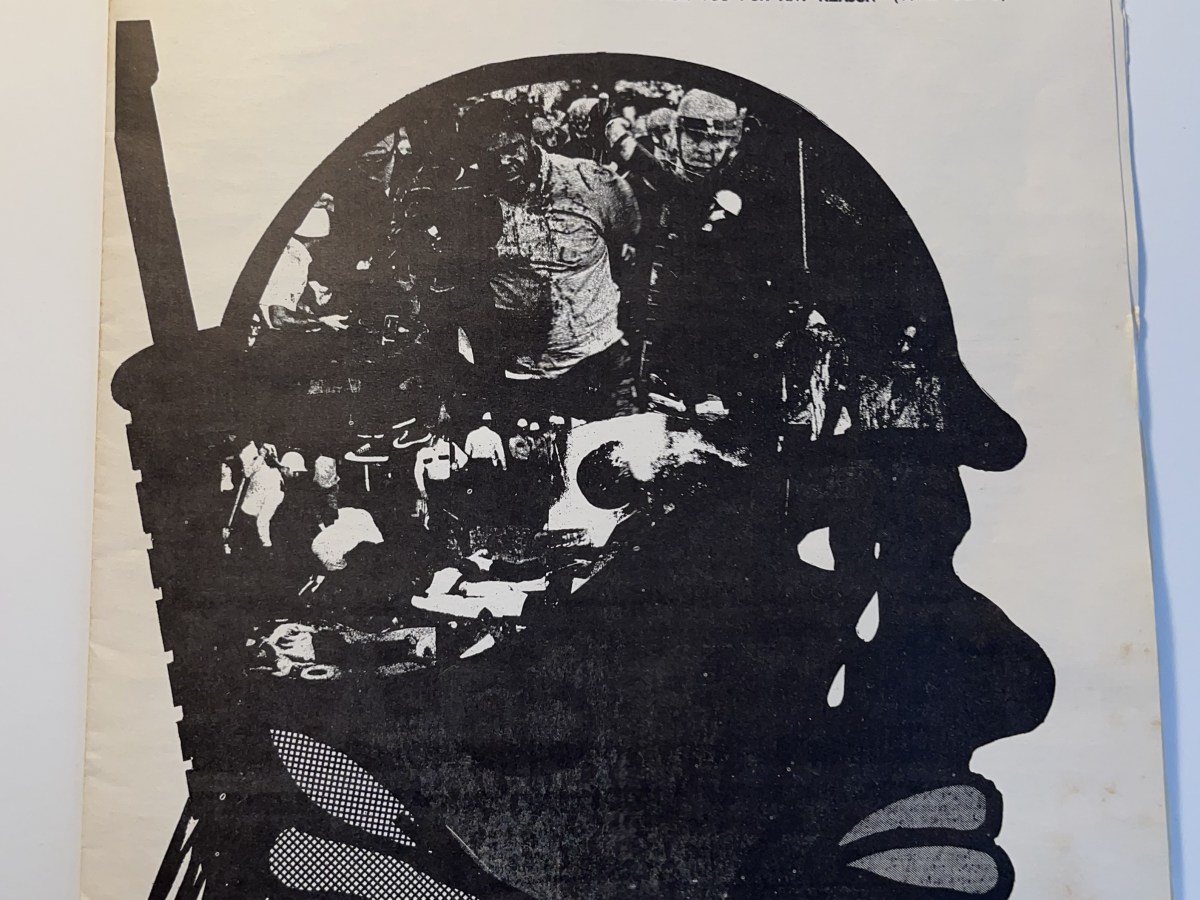
When I came home from Europe in August 1968, the antiwar movement was not new but it was gaining momentum. Young guys my age faced the threat of induction. I was called up twice for the pre-induction physical, but I managed to stall the first draft order by extending my student deferment and the second by submitting a conscientious objector claim on humanitarian grounds. This confused my draft board just enough so that my newly assigned lottery number put me barely over the line. When I was safe at last, a stomach ulcer I had been suffering for years magically…
Discovering Alain Badiou
I discovered Alain Badiou when I was holed up in a Montmartre apartment last November, collaborating on a research project by day and trying to improve my uncertain French comprehension in the evenings. In search of a clear, cognate-rich French, I googled politicians and authors. Then I happened upon Badiou about whom I knew almost nothing. After listening to a few of his presentations, I felt as if I had tuned in to Socrates himself. Like the Socrates of Plato’s dialogues, Badiou remains congenial even while mercilessly deflating the weaker premises of his interlocutors by asking essential questions. In a…
Germinal at the School of Acts
“Everyone needs a right of free movement, because the world belongs to no one; . . . goods move in large ships, even as human beings are deprived of the right to circulate . . .” Manifesto of the School of Acts. Aubervilliers, 2018. I’m not a prophet, but on the eve of the second round of French presidential elections of April 24, 2022, I had an experience that left me with the feeling of peering over the horizon into the deep future of the twenty-first century. I was in Paris for one of several visits to finish a research…
ALS Diary (part five): Thoughts on Remaining Human
On my way to the Credit Union this morning I happened to hear something on my car radio that I found moving. During the Second World War, while the Wehrmacht was inflicting its frightful siege on Leningrad, Shostakovich composed his symphony in honor of the suffering city. When the symphony was finished, the defending Soviet forces set up loudspeakers and broadcast the performance toward the German siege lines. One of the German soldiers later recalled the effect: “It began to dawn upon us that we would never conquer this city. The besieged were motivated by something more powerful than terror…
Discovering a Shameful Past Event in Paris
Paris is a city that clings to the past, commemorating it in the squares and streets that bear the names of famous battles (Austerlitz, Marengo, Stalingrad) and in its many well-marked historical sites. But there are sites and events that the city prefers to forget. In Montmartre where I stay, I overheard tourist guides haranguing their flocks about famous artists and night spots long before I learned from a book of Andrew Pfannkuche’s that those same streets and street corners near where I stay were the locations of bloody battles during the Paris Commune of 1871. Our friend Serge (Blanc)…
Apocalypse or Liberation: Narrative Patterns of Opposition
Where are we in the swirling ocean currents of history? Postmodernism has gotten us used to speaking of and distancing ourselves from the so-called “grand narratives”: the narratives of continual progress or revolution or regression. We could carry this metaphor of narrative structure further by attending to the motifs or recurring plot figures that historical actors impose in enacting history or scribes invent in recording it. Like any narrative, history is conflict and hence opposition. One can no more deny the presence of opposition than one can deny the passing of time. But the shape or terms of opposition are…

An Incident to End an Age: Kickapoo Creek 1970
Just over 52 years ago, between 30,000 and 60,000 people camped out on a muddy farm near Heyworth for Illinois’s own Woodstock: The Incident at Kickapoo Creek. Logan Janicki For college students across Illinois and neighboring states, L. David Lewis could hardly have chosen a better time to hold his “love affair” between “the electronic miracles and the human sounds of the soul,” the Incident at Kickapoo Creek outdoor rock concert. Nixon’s promise of law and order had proven to be nothing but the boot of the man coming down to crush peaceful dissent and hope for a better world.…


 Normal Thoughts