
Normal Thoughts
A Socialist Blog
Normal Thoughts
A Socialist Blog
This blog began during the pandemic in an open conversation among friends associated with the Democratic Socialists of America (DSA) and interested in history, philosophy, and socialist politics. We studied or taught at Illinois State University in Normal, Illinois. We have since scattered far and wide, but without abandoning our “normal” thoughts and aspirations. Without consensus or a program, we are united by our desire for a just and decent world. We are continuing the conversation with this blog so that we can record our conversations and share our sense of things with the like-minded. To all those who share our sense of the world, we gladly extend comradeship and an invitation to contribute.
Signed,
Andrew (Pfannkuche) – a PhD candidate in history at the University of Luxembourg
Andrew (Weeks) – a retired professor of German from Illinois State University
Cody (Kern) – a graduate student in history at the University of Wisconsin-Milwaukee
Erik (Lynch) – a PhD candidate in philosophy at Michigan State University
Josiah (Bloss) – an archeologist and Illinois nationalist crossing the Great Plains
Logan (Janicki) – a central Illinois librarian and amateur Byzantinist
Pierrette (Azais-Blanc) & Serge (Blanc) – two Parisians of the best sort
Ethan (Kirk) – a francophile and spreadsheet miner in revolt
Weeks Were Decades Happen
The era of Assad is over. Turkish-aligned Syrian rebels, first coming out of a small pocket in Idlib, captured Aleppo before driving south without being stopped. At the same time, rebels that had gone to ground in the south rose up and seized Damascus. What seemed like a permanent stasis only two years ago has sprung to life. Historical change is occurring minute-by-minute. In Syria, the old view of the world cannot be restored. Chateaubriand would tell us that the world before these last two weeks is one we cannot return to having lived through these historic events. Is the…
Keep readingThe Death of Andrew (Weeks)
Dear Reader, Andrew (Weeks) died on the night of 13/14 June 2024 following two years of ALS. Andy’s death leaves a hole in all of our lives and I cannot begin to convey the sadness I feel writing these words. He was an amazing teacher, mentor, father, husband, comrade, stranger, and friend to so many people. I invited us all to think critically about the world around us. About the machine of capitalism and of the plight of the migrant, who, in this 21st century, is to us as the slave was to the 19th and fascism was to the…
Keep readingALS Diary (final part): Everything Solid Melts: Music and Love Transcend
Für V., in Liebe geschrieben. Wrecked in route to nowhere. On the cusp of annihilation, Of last gasps and chaotic recall Of memory-splicing intellection, Gray as old snow, last ever to fall, I’m entombed in the icy-spectral residue Of an errant searcher’s existential wreck Were once-pure snow and rainbow-dew Blind omens of what our lives would lack? Or are these the stains of my wandering? Whatever melts can reveal nothing at all About the radiant future we once bought: We conjured up a holy grail of our imagining, Inspired by the love we bestowed and sought. And as the song…
Keep readingALS Diary (Appendix F): Where is the Exit Door?
In the last weeks of May and the first of June, I fell several times and found it impossible to get up from the floor without a strong pair of shoulders to hoist me onto a chair and help me rise from it. I approached the subject of full-time care. I think we will have to take this up with the hospice nurse. To think of leaving the world in springtime?!
Keep readingALS Diary (Appendix E): Marginal Mobility
N.B. – From two weeks ago. I can still hoist my body into the power chair, navigate to the bathroom, brush my teeth, pivot onto the toilet, clean myself, and then make the return journey to the chair or sofa where I began. All of this. But just barely. I choked this morning on my oatmeal but I don’t usually do that. I can still eat and I can breathe. No red line has been crossed yet. Signed, Andrew (Weeks)
Keep readingALS Diary (appendix D): Hospice
For two weeks since the beginning of April, I’ve had a urinary catheter. Yesterday my wife agreed to allow a representative of the hospice service to visit and explain how it works. The nurse and case manager has paid her visit now I was satisfied and Veronika hit it off with her especially well, so it is all good. My momentary woe is this unusual ALS-conditioned constipation that constantly simulates a bowel movement that then doesn’t follow. But the upside of things is that we can now count on the practical help of a skilled and approachable nurse. Urs and…
Keep readingALS Diary (Appendix C): Hitting the Treetops
You could compare the trajectory of my ALS decline to the descent of a plane that has lost power. First comes the long smooth decline, then you graze the tallest tree crests. The flight is no longer smooth but it’s not yet the crash. Two weeks ago I began to suffer constipation which made me wonder if the muscles that serve the purpose of expelling stool were atrophying. As I got over the constipation, I began to pee with great difficulty and soon with pain. Yesterday I went, in considerable pain, to the Emergency Room where they drained what looked…
Keep readingALS Diary (Appendix B): The Imminent Crash
Now I feel exhausted in my entire body. I’m not in acute pain, just tired. In the back of my throat a sensation of nausea that could be a response to hunger or related to the onset of the paralysis in the throat muscles. I can imagine already longing for the big sleep. It won’t take me by surprise. I’m writing now mainly to record the process for the benefit of my fellow sufferers. Yesterday, March 18, I went to the YMCA. James Freeman accompanied me and helped me get dressed and undressed. I was in a wheelchair. I can…
Keep readingALS Diary (Appendix A): A Steeper Decline
Now it’s a few days more than a year since I received the diagnosis and a good two years since I first suffered the symptoms of ALS. It may be worth knowing that, in my case, there is a steeper decline at this point. I could still get around at the Y with a walker, but it is very exhausting. My appetite is also declining. Chewing makes me break into a sweat but I can swallow without choking. My speech is normal. I am in control of my bowel movements and urination. I am annoyed that so few friends or…
Keep readingAn Invective Case for College Admissions Exams
Matt Breunig recently released a thoughtful essay on the importance of standardized tests for college admissions. I thought it would be worthwhile to respond to it because it’s about time that I wrote something about our education system after a year and a half of trying my hardest not to think about it. I largely agree with Breunig’s argument that test-optional admissions for highly competitive universities favor the scions of the rich and well-educated. But we might as well point out the obvious: the whole country favors the scions of the rich and well-educated. This is beyond dispute, but it…
Keep readingALS Diary (part 60): Calling It Quits
I’ve been promising to put an end to this ill-advised account of my decline, and I think the proper moment has arrived. I came to this decision because on the one hand, it was becoming too much like a compulsion, one that urged an over-dramatization of the banal condition of dying, and on the other hand, I simply prefer to exercise agency and end on an upbeat. Now is a good moment for doing that. If I post anything else here, it will be as an appendix and afterthought. Now is the moment when I can confidently embrace the positive…
Keep readingALS Diary (part 59): My Changing Condition Two Years In
I decided to cut back on and cap my diary entries. The increasingly political material will go on another site. On this one, I will report tangible changes in my condition. I realized that the compulsion to keep an ALS Diary was pushing me to overdramatize what is in fact a completely boring decline. True, it did give me a sense of control, but it distorted my day-to-day experience. Some benchmarks have been met. In December, I received the motorized wheelchair. It was high time. So far, I have avoided having to use it, but this will come soon enough.…
Keep readingALS Diary (part 58): Losing My Legs, A Warning to be Strategic about Bowel Movements, and Reading
In my last ALS Diary post I expressed my regret for subjecting readers to so much of the same thing (it’s always “a little worse”) along with so many extraneous thoughts and comments with a kind of cheap solemnity and faux depth. I decided that I should limit the entries and cap their number. This will mean saving the last few for when my ability to write is starting to fail. Now, however, I have a noteworthy transition. Two days ago, my power chair was delivered. An excellent employee John North spent a couple of hours explaining how it works…
Keep readingWhat can I say about Gaza?
Yes, in its own unprecedented way, there is something uniquely horrible about a well-armed state raining down bombs and fire on a densely populated area where two million civilians are ordered to flee this way and that without the protection of their houses that are being blasted to rubble and without dependable sources of water, food, or medical help. I don’t trust formulae that evaluate and compare atrocities; but this is unparalleled as a public spectacle of helpless families caught in a narrow corridor, hammered and harried from every side. Do the supporters of Israel imagine that the world will…
Keep readingALS Diary (part 57): The Circularity of Regrets; Kicking the Habit of Living
First of all, I regret having started this ALS Diary to begin with. I must have expected it to elicit some ultimate profundity, which of course it cannot. I expected it to confer a sense of control over the process of decline; but that sense instead morphed into a kind of self-imposed tyranny. I have to keep it up just to confirm that I can keep it up. Finally, I thought it might prove useful for other sufferers to follow my experience of decline along with the feelings it elicits. Unfortunately, my disease is so stealthy that I find myself…
Keep readingRealism and Revolution: Franz Kafka
It’s not easy for post-millennials and digital natives to recapture the dimensionality of pre-internet communications. Where once a single movie commanded the simultaneous attention of hundreds of viewers, now each of us commands, Alladin-like, a hundred thousand genies to be summoned by the stroke of a fingertip. Has this vastly augmented power instilled confidence and wisdom in the public? It has more likely split a mass once susceptible to consolidation into a million errant souls. Once upon a time, authors lent guidance to those eager for enlightenment. Authors could speak for their generation. They could orient readers in history and…
Keep readingBalli Kombëtar, Albanian Fascism, and the Death of Nineteenth-Century Nationalism
I’ve recently returned to my Albanian history ways. I became interested in the subject after my application to be a Peace Corps English teacher in Kosovo was accepted. I began reading about Albanian history in January 2020, but after COVID made the Peace Corps impossible, I found myself sucked into the world of Albanian history. This wasn’t truly out of the blue. eRegime, a forum that I used throughout high school, is run by its benevolent dictator and Albanian history enthusiast, Ismail. Ismail has other interests (principally Katanga), but I reached out to him in the early days of COVID…
Keep readingALS Diary (part 56): Reflections on the Brink
One peculiarity of ALS: you feel your body slowly dying even while your mind is unaffected, free to contemplate your whole existence even as you are soon to depart it. Since throughout life you’ve been haunted by the feeling of things needing to be done (Good heavens! how onerous that was for me as a school kid!), now that there are no future obligations to fulfill, the sense of obligation turns from the future to the entire past and asks what you should have done in life but didn’t. It’s a self-administered Judgment Day for the secular. Did I neglect…
Keep readingALS Diary (part 55): Some Things I’ll Never Understand
I don’t get it. Here is a site under the aegis of a self-declared Marxist and socialist, Freddie DeBoer, whose followers (though clearly not all of them) regularly applaud his posts with the warmest accolades, yet one gets the impression that such terms as “expropriation” or “worker solidarity” are absurdly out of place here. These terms are not memes. They are ideas that should be assessed on their merits. Expropriated state-owned banks are hardly peculiar to Hugo Chavez’ Venezuela. Sure, the stupid comments may be toxic internet voices, but the degradation of political discourse is awful in any case. I…
Keep readingALS Diary (part 54): Isn’t Killing Worse than Dying?
Here are my thoughts on the present cacophony of responses to the situation in Israel/ Palestine: One man can kill another man but one truth can’t kill another truth. Many things on the ground are invisible from a height of 10,000 feet or from an equivalent historical distance. Their invisibility isn’t the same as their non-occurrence. This is true whether the distance is the altitude of a bomber or the historical perspective of a moral observer. Even during the climactic phase of the “good war” of Britain and its allies, there were British voices that protested the indiscriminate bombing of…
Keep readingALS Diary (part 53): Solidarity in extremis
Recently, I stumbled into the new world of online discussion or group chat, which seems to have been shaped by Twitter/X. I’m inclined to see it as a commodified version of the Renaissance and Enlightenment-era tradition once known as the “Republic of Letters.” Before European countries achieved a measure of egalitarian and democratic polity, thinkers, poets, and authors, from Erasmus to Goethe, engaged in an egalitarian exchange of opinions, knowledge, and ideas by correspondence and, not rarely, by house visits. We no longer knock on the door of an admired writer; but well into this century, my wife and I…
Keep readingALS Diary (part 52): Life and Schopenhauer’s Will; Love Versus Solidarity
What is the measure of life? Voltaire philosophizes about the response of a fine young man who in consequence of falling off a horse became quadriplegic—reduced to a life without activity, physical love, or initiative of any sort. Voltaire expresses wonderment that the young man nonetheless loves life. I have heard from my neurologist friend Herman a similar story of a young man who fell out of his hunting stand and became a quadriplegic. One of our dearest old friends in Austria was a retired physician, still entirely healthy and active. He fell from a ladder while pruning a fruit…
Keep readingALS Diary (part 51): The Little Delights of Daily Living.
“He wanted to live in his wealth of minutes, the ones he had left anyhow.” said of the retired Irish detective Tom Kettle in Sebastian Barry’s Old God’s Time What are the little delights of daily living? I can’t say that they include food. I do get hungry and I retain my sense of taste. But there is no pleasure in eating. Foods I long for are tedious and boring in the eating. I have lost my taste for alcohol or sweets. Walking, which has given me pleasure throughout life, is no longer possible. I watch others saunter along as…
Keep readingALS Diary (part fifty): Kitsch and Death
“Kitsch is a folding screen set up for curtaining off death.” Milan Kundera, The Unbearable Lightness of Being Kundera is generalizing from the forced positivity of May Day celebrations in socialist Czechoslovakia, where the Communist authorities had declared the struggle between good and evil to be superseded by the progression from good to better, a formulation that cries out for kitsch. Obviously, the forcibly upbeat tone was designed to cover up the repressive official background which included the torture and execution of founding Czech Communists. However, Kundera extends his generalization to America, where idyllic childhood scenes fulfill a similar function…
Keep readingA Trip to Normal
By Ethan (Kirk) Is something like this worthy of a foreword? Well, if this is me actually committing to something, and giving something I’ve wanted to do a wholehearted effort, I guess it does. I’ve always enjoyed traveling, and despite having intense social anxiety my entire life, I can always make conversation. It’s never felt like it takes effort; I can usually judge within a minute or two whether someone is open to talking, and what they’d like to talk about. I find ways to pass the time chatting with people who seemingly have nothing in common with me. I’ve…
Keep readingALS Diary (part forty-nine): We Scholars: Actors Without a Stage, Musicians Without an Audience
Sheets of paper covered with words pile up in archives sadder than cemeteries, because no one ever visits them, even on All Souls’ Day. Culture is perishing in overproduction, in an avalanche of words, in the madness of quantity. Milan Kundera, The Unbearable Lightness of Being I don’t regret the direction of my life and academic pursuits, even though I know how futile it arguably all was. When I look at the ecology of humanities scholarship, I see all the wasted energy and the vain longing for recognition or impact. I know the doomed passion of the young scholar. I…
Keep readingALS Diary (Part forty-seven): An Updated Theme of the Double: Are We Really Interchangeable?
We just finished watching Orphan Black (Laura in Urbana and me here at home). I had seen it before. So had she on my recommendation. It grows on you, so another viewing was worth it. Orphan Black is thought-provoking fare for the ALS patient or anyone intrigued by the mystery of life. OB implicates questions concerning freedom and solidarity. It is simply fine entertainment thanks to the genius of Tatiana Maslany and the intelligence of the CBC. The philosophical questions at play: genetic determinism Genetically speaking, we are like material organizations controlled by encoded sets of instructions that determine who and…
Keep readingALS Diary (part forty-six): Why Does Letting Go Get Such a Bad Press?
After a lunch conversation with Terri in which, inevitably, the topics of illness, pain, and death came up, I read a thoughtful and moving New Yorker article by Peggy Orenstein in which she recollected her father’s old age dementia. The New York Times had an article recently about Dutch communities for elderly sufferers of dementia. I believe that these may be humane and progressive developments that should be lauded. Whether they are the priority on an overcrowded planet is another question. It’s a problem: the fact that even addressing the question of priorities is discouraged by what we call “the…
Keep readingALS Diary (part forty-five): Normalizing Death and Dying
It’s absurd to talk about normalizing death since nothing could be more normal as it is. Nonetheless, we all naturally fear it. Aside from its horrific variants wrought by violence or disease, death means a foreclosure of all human possibility. No other living creature, we are told, knows that it will face this foreclosure. It might be the case that wounded animals do sense that they will die; but I am ready to accept the thesis that no other creature contemplates its demise with so much distance and freedom. Yes, we are free to think the unthinkable foreclosure of all…
Keep readingALS Diary (part forty-four): Nietzsche and the Lyric Poetry of Death, “Die Sonne sinkt”
Nietzsche’s poetry, which we too often try to unlock with the code of his labyrinthine philosophy, is accessible to existential empathy. He was a loner whose body was signaling its imminent demise but whose spirit could still rouse itself to flights of incandescent illumination. I’ve known that condition since my student days. I know what it means to lift off to the heights of thought and feeling evoked in Nietzsche’s loner poems. In “Venice,” his solitary soul in flight sings softly to itself. I know what it’s like to ask, Does, or will, anyone hear my soul’s music? I know…
Keep readingALS Diary (part forty-three): Nietzsche’s Cartoonish Contemplation of Death
Several of Nietzsche’s most beautiful poems can be read as contemplations of death. As such they can be both unsettlingly strange and grotesquely funny (not unlike the Mexican artist Jose Posada’s crazy strutting and partying skeletons, though Nietzsche is deeper and more layered). For someone facing off with our cartoonish Grim Reaper, this sort of humor can have a palliative effect (unless you are the morose kind who can’t take a joke about such matters). I’m thinking in particular of Nietzsche’s longer poem “Die Wüste wächst.” In English it’s “The desert grows” (but that unfortunately sacrifices the terse alliteration of…
Keep readingALS Diary (part forty-two): Looking Backward, Forward, and Summing Up; The Death of Ivan Ilych
It’s been almost five months since I was diagnosed with ALS and more than a year and a half since I began noticing my symptoms. Two years ago, neither I nor anyone observing me noticed the plodding gait that I would soon exhibit. Since then my walking, my strength and balance, have gotten steadily worse so that now I am beginning to doubt that in a month’s time I will still be able to move without a walker and soon after that a wheelchair. The descent has been steady, but recently I became aware that I’m embarking on a new…
Keep readingALS Diary (part forty-one): How the Novel Ends and What it Makes me Think About
Frank Bascombe’s ALS-afflicted 47-year-old son Paul in Be Mine is not autistic, but in his relationship with his father he is tactlessly out of synch, tone-deaf, and entitled. His father rents a camper mid-winter and takes him, caviling and complaining, to see the World’s Only Corn Palace and the stone presidents of Mount Rushmore. Upon arrival in sight of the monument, Paul—who adores the kitsch and curios his father despises—exclaims: “It’s completely pointless and ridiculous, and it’s great.” This confirms the Chekhovian aspirations of Richard Ford’s narrative. As his narrative voice intoned 200 pages earlier, it’s a “non-event that means…
Keep readingALS Diary (part forty): More Literature of the Moribund – Bascombe, Zorn, Ivan Ilych, Everyman
After finishing Fritz Zorn’s Mars, I’ve started another book in the same vein: Richard Ford’s Be Mine. It’s not cancer-themed like Mars, but specifically ALS-themed, narrated by a father whose 47-year-old son Paul is dying of a faster-acting variant of what I have. That’s what motivated me to mention it to my wife who bought it for me. Mars and Ford’s Be Mine are both very much bound to their time and place, intentionally so for Ford but inadvertently in the case of Zorn. Mars is the work of a young man versed in the classics of European literature and…
Keep readingALS Diary (part thirty-nine): Plain Words about an Exit Strategy
I’m grateful that my wife went with me to my neurological appointment in Peoria. I’m grateful that she not only took part in the conversation with Dr. Zallek but even stayed with me (I asked her if she preferred to go outside) when I brought up the matter of what I call my “exit strategy”. Zallek went into some detail about what it might feel like when my lungs stopped working (“like trying to inhale through a straw that is too narrow”). When we left to go to our car, I commented that I have no intention of becoming an…
Keep readingALS Diary (part thirty-eight): Narratives of Death and Revelation
It’s an old genre, the tale of the blasé protagonist who only faces ultimate reality in a confrontation with death. First of all, there are the many iterations of the late medieval, early modern Everyman-plays. Tolstoy’s The Death of Ivan Ilych shares the lightening simplicity of those dramatic treatments. But I want to consider a more recent treatment, one that affected my wife and her generation that reached maturity in the 1980s (in Switzerland or her similar Austrian setting of Salzburg and Vienna where she turned 22 just before I met her). I’m interested in considering Fritz Zorn’s Mars because…
Keep readingALS Diary (part thirty-seven): An ALS Webinar on Palliative Medicine
Last night, I took part in a webinar on palliative medicine designed for ALS patients. I learned some things that my doctors hadn’t mentioned (such as that ALS can affect cognitive functions). One possible ALS symptom has the effect that the patient cries when something is funny and laughs when something is sad. By the way, this is how Brecht wanted spectators to respond to the actions on the stage of his epic or dialectic theater. Maybe the patient gains some special dialectical insight. The deep personal commitment of the speakers was touching; and far be it from me to…
Keep readingALS Diary (part thirty-six): The Invisible Brother- and Sisterhood of the Initiates of Death
Now it’s becoming clear to me that my friends and acquaintances can be divided into two distinct groups. There are those who are on familiar terms with death. They talk about my condition with matter-of-fact sympathy but without much ceremony. And there are those who shy away from me because the looming Grim Reaper makes them uncomfortable. He’s like some visiting dignitary from an alien realm. They are republican citizens, unsure how they should defer to a powerful dignitary who might carry them off into his shadowy entourage with its myriads. They know where they stand in the Republic of…
Keep readingALS Diary (part thirty-five): A Secret Brotherhood
On Saturday I had lunch with a friend named Tony (she is close to Jim and Nancy) and with another lady my age or a little younger from the same circle. The Indian buffet is a place that I once loved to patronize on Saturdays midday. Now the spices have gotten too potent for my damaged taste buds. The radiation oncologist who treated me seven years ago neglected to inform me that the damage to my mouth and throat would get worse with time. On Sunday I invited Mark and a lady who swims at the same time in the…
Keep readingALS Diary (part thirty-four): The Palliative Power of Love
Last night, I happened to read a promising, but in the end rather disappointing, New Yorker article on “transference in the classroom” (essentially this is about the student or teacher seeking from the other the love or approval missing in family or conjugal relationships). The effect of stale Freudian concepts addressed to current pedagogical issues was comparable to cooking up some daring new dish using leftovers that had already acquired an odd odor and color in the back of the refrigerator. First, it’s certainly obvious that we need love; and, if it’s absent in one sphere, we seek it in…
Keep readingALS Diary (part thirty-three): Comparative Notes on the Terminally Ill and their Families
So far, I haven’t signed up for an ALS support group or tried to persuade anyone in my family to go to one, but my friend Laura has been spending time with her father who is about my age and has terminal leukemia. It helps to hear from her about getting along with her father (“BFD”): 🙂 i woke up to pee at 3 am and caught sight of the easy chair that my dad sits in and saw he was in it instead of in bed and he had insomnia so i sat in the dark with him in…
Keep readingALS Diary (part thirty-two): Countercultural Continuity
Recently, I read an article about Constance Garnett, the prodigious turn-of-the-century British translator of the great 19th-century Russian authors. I remember her steady English voice so clearly. It accompanied my adolescent and young adult reading. It resounded in contrast to the extremes of the translated Russians. It was like hearing a staid clinician recount the ravings of the outraged or the cries of the crazed and desperate. If I thought about her, I assumed that she was a self-possessed Victorian, not quite a prude but not someone who shared the extremes that she rendered in prim and proper English. It…
Keep readingOn the (im)Proper Uses of Public Space
19 June. I have a free day in Paris. My thesis has been submitted, Léa (with whom I have been spending my time with since Andy returned to the States) is at work, and I have no plans for the day. I have been reading Christopher Clark’s Revolutionary Spring which was published two weeks ago by Allen Lane. The book is engaging and well-written. It looks forward to the Arab Spring as parallel to the year’s revolutionary expectations (and failures) as well as the current ‘polycrisis’ as something akin to the Hungry Forties. He ends the book powerfully, telling us…
Keep readingALS Diary (part twenty-eight): the Body Declines, the Soul Hits Bottom, & Brother Lear
Following the downward progression of an ALS patient is truly about as exciting as watching paint dry. Yesterday, I had a conversation related to relationships within my family that for once I am going to withhold. Actually, it’s wrong to say “for once.” I’ve always held back and also often intimated family problems. Still, the recent experience was a nadir. But is that true? Things unfortunately can always get worse. It was bad enough so that, paradoxically, it calmed me: No need to be tormented by suspicion concerning my children. My worst fears in this one instance have been resolutely…
Keep readingALS Diary (part twenty-seven): Reflections of Where I come from, Rachel Cochran’s ‘The Gulf’
Four years ago, I decided to spend time in the poor southern region of Illinois (“Little Egypt”) where I am from. It was a bit like exploring the ruins of an abandoned civilization. I saw small towns that had once been rich from mining or river commerce. Once sizable towns had been reduced to modest, impoverished rims surrounding once busy squares, once grand theaters, and outsized public buildings. I saw ragged curtains flapping through broken store windows, oasis-like village cafes, and the desolate main street of the town I grew up in. It was haunted by my memories of alluring…
Keep readingALS Diary (part twenty-six): Living Badly, Dying Badly
From a New Yorker article about terminal ALS patient advocates demanding drugs that the FDA has not yet adequately tested, and the hatred faced by critics and dissenting ALS patients: The skeptical [ALS] patient told me that he thinks about this all the time. “There are maybe twenty-five thousand of us now,” he said. “But when you do the math the total number of people in the U.S. who will ever get A.L.S.—maybe five years from now, maybe seventy years—is well over half a million people, and we owe them actions and policies and principled behavior that maximize the odds…
Keep readingALS Diary (part twenty-five): Father’s Day
I’m behind in my planning. I can see the phase fast approaching when I will no longer be able to make it to the bathroom or use the toilet on my own. In my vague expectations, I had imagined that I would first reach the phase where I could no longer swallow or breathe unaided. At that point, I would refuse all artificial life support and make my exit from this world. But what if I have to accept a transferal to a nursing home, the very thing I’ve hoped to avoid? My wife and children would pay routine visits…
Keep readingALS Diary (part twenty-four): Settling Into a Routine
Any reader of this blog must get tired of reading the same report of my worsening condition. I can understand that. My balance has gotten worse since I am home. My hands and forearms are subject to unpleasant cramps. My lap swimming has come up against my shrinking endurance. By the end of the second or third lap, I’m no longer able to propel myself forward in the water. Exhausted, I find myself treading water before I reach the end of the pool. At home, I can still heave myself upright, but maintaining myself has become extremely challenging. Even going…
Keep readingALS Diary (part twenty-three): A Favorable Turn of Events
I regret the depressing inexorability of a diary in blog entries documenting the progress of an incurable disease. I have thought seriously about shutting it down and having it deleted, or at least relegating it to an even more private space. That was difficult for technical reasons. But now I feel that though I am only writing for the thinnest niche within a niche, there are reasons to put these things on record, reasons besides the sense of control it gives me. For one thing, it’s possible that my family might someday want to know my thoughts and feelings. For…
Keep readingHistorical Joy, or Why I Wrote My Thesis
This blog will be brief. My master’s thesis is now complete and I wish to share it with the world. My supervisor will probably emphasize the unscientific nature of my work. Perhaps I could have chosen sources systematically rather than in the hap-hazard nature that I did, going from one archive to the next in search of this or that missing document to complete the story I wanted to tell. Perhaps I could have included more theory. Perhaps I could have read more books, cited more contemporary scholars, or demonstrated my fealty to the tax haven by including a digital…
Keep readingALS Diary (part twenty-two): Kick-Starting my Social Life Back in the USA
For most of the week after flying back home, I’ve felt achy and weak. Naturally, I saw this as a portent of pain to come. And maybe it is. But at the moment, I rather think that it’s being under the weather. I’m hoping that tomorrow things will brighten up. Tomorrow I’ll meet Jim and Nancy for dinner. It was good to have dinner with Jim and Nancy. They are good-hearted and sensible as always. They could call themselves Socialists, Social Democrats, or Christian Socialists. Historical socialism would have embraced them and been embraced by them. I suspect that there…
Keep readingALS Diary (part twenty-one): At home again, I’ve lost ground
Yes, I have lost ground. I knew that I was losing ground in Paris and I expected to lose ground even before I left for Paris. I expected it to be worse in fact. Nonetheless, while in Paris I blamed my losses on the sloping uneven streets and on missing my exercise routine at the Y. I consoled myself that, seated before guests in my apartment, I was as good as ever. I could sit and chat for hours. I could navigate around my narrow kitchenette to make tea or open wine for my guests. Pas de problème. Now, back…
Keep readingALS Diary (part twenty): Waiting for my Flight at CDG, in Flight, Home, and why this ALS Diary was so Problematic
Now, after the warmest and most helpful send off I could have asked for, I’m waiting for an hour at my CDG departure gate. The sky was a perfect blue on the way here and the air had a pleasantly cool freshness. I’m noticing my compulsion (which is a characteristic tendency of literature professors) to turn even the most ordinary and banal setting and occurrence into a bearer of symbolic meanings. I can imagine what Jean Cocteau might have made of it here, more than Jacques Tati could manage, more than Hollywood could even dream of. Symbolism and Surrealism opened…
Keep readingALS Diary (part nineteen): Wrapping it up; Last Thoughts in Paris
I began writing the last blog entry the day before yesterday, continued writing the rest of it yesterday, had visitors all day today (delightful but exhausting) and will be packing and saying goodbye tomorrow at lunch, and then on my way home the day after tomorrow. When nothing happens, I don’t know what to write. When a lot happens I don’t have time to write. Should I write that I often now, between other activities, think about the end of my life? I’m surprisingly calm about that. Perhaps it will be painful. Would it be any less so, if I…
Keep readingALS Diary (part eighteen): My condition is Worsening; the Home stretch
Recently I could tell that my condition was getting worse. It was harder to maintain my balance, harder to get up the stairs, harder to go to sleep at night. However, my part of our project is as good as done, and Didier had only ten pages to go. In five days, I’ll be in the hands of Air France and then in those of my daughter and wife and then home. Before I leave, I will see Kathrin from Heidelberg, Matti and Lucy, Jean-Marc Mandosio, and Pierrette and Serge. I plan to invite all my friends to lunch on…
Keep readingALS Diary (part seventeen): What is the Role of Compassion in Oppositional Politics?
There are rules of courtesy that have nothing to do with the use of tableware: anyone who happens to hold a position of dominance (for whatever reason) should see to it that the (for whatever reason) disadvantaged get their turn. Do that, and do it even for the homely self-conscious kid on the sidelines. Show the overweight awkward passenger the same courtesy you would afford to Madame La Bourgeoise. Simply by putting yourself in the shoes of the other, you will gain respect from those around you. I’m sorry to say that it’s only since I’m an old man that…
Keep readingALS Diary (part sixteen): A Conversation and an Exhausting Walk to the Montmartre Cemetery and Back; Thoughts about Compassion
On Wednesday, Pancake is still in Luxembourg. Serge and Pierrette come for lunch bringing everything with them. I am impressed and pleased by the simplicity of their typical meal, an unvarnished puréed cod dish, baguette, cheese eaten with bread and with simple leaves of lettuce unsalted and fresh strawberries unsweetened. We talk for quite a while in French. I ask about Serge’s family and about Pierrette’s philosophy and experience teaching. I ask them about French schools and am disappointed when they reply that they are abîmé. I was hoping to hang on to my admiration. After our long lunch conversation,…
Keep readingALS Diary (part fifteen): Walking Is Getting Harder; Solitude and Memories of my Children
Pancake is back in Luxembourg to defend his M.A. thesis. I don’t mind a bit of solitude but my mobility outside the apartment is limited. I don’t fancy the prospect of a broken hip or leg. I’m noticing that it’s harder to maintain my balance or climb the curving narrow staircase that leads up to my second-floor apartment. There is something unexpected about how ALS spreads, which might explain the “lateral” in amyotrophic lateral sclerosis. It’s been a year since my feet got numb, and the numbness is slowly intensifying, but instead of rendering my feet totally useless, it’s spreading…
Keep readingALS Diary (part fourteen): Memories of Comradeship, a Night of Desolation
Last night, the balance tipped from sweetness to bitterness and I had a bad night. There are rules I have to follow. My only way out is into the past. So speak, memory! Pancake has begun to remind me of my erstwhile close friend and comrade in the antiwar movement, Gregg Gauger. Same long hair. Same physical enthusiasm when speaking of the quirks and oddities of politics. How important it was and is to have a comrade you can rely on and work with. Gregg took pleasure in the layout and production of our antiwar publication. I was the content…
Keep readingALS Diary (part thirteen): A Splendid Day with Friends and Memories
It’s a beautiful mild and sunny Saturday. Serge and Pierrette came for lunch, bringing an unlabeled bottle of red wine from her home in Gruissan. It had the taste of simple friendship and hospitality that I associate with Narbonne, which is next door to Gruissan. When I first found out where she is from I called her Nausicaa, and her Occitan home was for me the generous land of the Phaeacians which shelters Odysseus on his homeward journey. This association goes back to a simple encounter, meaningful only to me, during my three-day journey hitchhiking from Paris to Barcelona in…
Keep readingALS Diary (part twelve): Memory as an Escape back to Reality, Dammtor Station
Now that I’ve realized that nothing is more important than not obsessing about my condition, and that one of the best palliative medications is memory, I’m indulging mine and finding that it’s more than ready to do its part. Pancake is a willing audience with his experiences that resonate with mine. This rainy Friday in May reminds me of a perpetually rainy Hamburg where I arrived—clueless—on a Friday in early September 1967. Since it was at the Dammtor station that I arrived at the university and where I frequently came and went, the neat little remnant of the prewar city…
Keep readingALS Diary (part eleven): An Intermittently Rainy Day in Paris & the Fisher King
On Tuesday night, I went to sleep a little earlier and slept soundly throughout the night. To anyone with ALS or undergoing treatment for cancer like me seven years ago, I would strongly urge that they always aim for a good night’s sleep. It’s therapeutic, good for the mind and for the body. Loss of sleep is the way those maladies make us their ally in our own destruction. You can defeat them, or at least resist them for as long as possible, by refusing to obsess about them. If our bodies are an open city, our minds can still…
Keep readingALS Diary (part ten): My Second Week in Paris
From Sunday to Monday, I slept better and then felt better getting up, but by 4 pm I am more or less exhausted. We’ve worked well today and I am confident I can finish the project I came here to do. After a modest dinner, Pancake and I walk to the Place des Abbesses, buy ice cream, watch people pass by, and, since it looks like rain, beat a path back to the apartment. It’s a gray evening, but like every evening, it’s loud with the voices of revelers and tourists in the street outside. Taking my hearing aids out…
Keep readingALS Diary (part nine): Friday and Saturday in Paris
Again, I got up relatively early, before seven today, and the three of us, Urs, Didier, and I, worked through much of the day, pausing at one o’clock for a carry out lunch of bakery pizza. This has the advantage that it gives me a full-day of effective activity and hearty companionship with a minimum of movement. By 3:30, I am tired and lie down in the adjoining bedroom for a rest. In the evening, the four of us with Matti go to BiBiche for dinner to see Urs off. He leaves tomorrow and he and I both know we’ll…
Keep readingALS Diary (part eight): An Early May Morning in Paris
It’s a crisp May morning two days after May Day. I slept well and we undertook a small expedition into the rue Caulaincourt for groceries and a sidewalk cafe. The Café qui parle wasn’t open yet, so I sat on a bus stop bench while Pancake took our shopping list to Franprix, and I watched the high tech operation of hoisting furniture up through the front window of a fourth-floor apartment. The air had that mixture of night freshness and matinal exhaust fumes so typical of metropolitan streets everywhere, though of course the mix is always unique. I don’t dream…
Keep readingPetits miracles
Andrew (Weeks) has commented on the miracle of walking since he arrived in Paris. I can sympathize and I want to argue in favor of a second miracle that we also take for granted: language. I’m not a great language student as all my long-suffering German teachers can confess. I lacked the discipline required to seriously study German. Der, die, das, die, den, die, das, die, dem, den, der, den, des, der, des, der. Still, I went after the language for six years as though I was General Haig. Constantly battering at the German trenches, hoping that this breakthrough would…
Keep readingALS Diary (part seven): Arriving in Paris and Acclimatization
On Thursday morning, Didier met me at the airport and we got to work as soon as we arrived in the rue Tholozé (after we had eaten at a deli across from my apartment). We worked all afternoon. In the late afternoon, Pancake (Andrew (Pfannkuche)) arrived from Luxembourg. On Friday, we kept to the same routine. When we walked down our sloping street to shop in the rue Lepic, I nearly collapsed after mastering the upward slope and the narrow curving steps leading up to my door. Once, I even sank to my knees and had to crawl across the…
Keep readingALS Diary (part six): A Long Saturday and into Sunday Three Days Before Paris
I forgot to post what I did and thought on the last weekend before leaving. First Felix came over for a long morning conversation about politics, the allure of Adorno, his Ph.D thesis, and his new gig at a Catholic Benedictine College near Naperville. At 1:00 pm I went to the conversational luncheon of the volunteer tutoring program I’ve been involved with, hoping to get some leads or some assistance finding household help in the summer. After this, I picked up Erik and his friend Ben, whom he knows from his French class, and brought them over to our house…
Keep reading
May Day in Paris
No amount of romanticism can prepare you for a Paris May Day. After a brief speech by Jean-Luc Mélenchon, the march began. The man had said little but he was still the person who embodied our resistance to Macron and an inhumane France. He was followed by Mathilde Panot addressing women’s issues. After her speech, militants began migrating to the starting point of the May Day march that I would be participating in. Mélenchon and his colleagues did not stay for the march and left at the first opportunity. When I reached the starting point, I watched from the sidelines,…
Keep readingALS Diary (part five): Thoughts on Remaining Human
On my way to the Credit Union this morning I happened to hear something on my car radio that I found moving. During the Second World War, while the Wehrmacht was inflicting its frightful siege on Leningrad, Shostakovich composed his symphony in honor of the suffering city. When the symphony was finished, the defending Soviet forces set up loudspeakers and broadcast the performance toward the German siege lines. One of the German soldiers later recalled the effect: “It began to dawn upon us that we would never conquer this city. The besieged were motivated by something more powerful than terror…
Keep readingDiscovering a Shameful Past Event in Paris
Paris is a city that clings to the past, commemorating it in the squares and streets that bear the names of famous battles (Austerlitz, Marengo, Stalingrad) and in its many well-marked historical sites. But there are sites and events that the city prefers to forget. In Montmartre where I stay, I overheard tourist guides haranguing their flocks about famous artists and night spots long before I learned from a book of Andrew Pfannkuche’s that those same streets and street corners near where I stay were the locations of bloody battles during the Paris Commune of 1871. Our friend Serge (Blanc)…
Keep readingALS Diary (part four): Another Day, Another Doctor
Zallek will be my last one, so it’s good that we got on well. He reserved two hours for me in order to gauge my reflexes and responsiveness. If he sees a fair number of ALS patients, I can imagine that he has to blunt the force of the diagnosis and perhaps struggle with disbelief and the reactions of those who blame the messenger for the bad news. Since he seems to genuinely care, it may be a burden. If so, he may have been relieved that I was cheerful, uncomplaining, ready with my questions, but not demanding that he…
Keep readingALS Diary (part three): Reading the signs of ALS; reading myself into Riker’s Guest Lecture.
Five days ago on the way to the supermarket I felt a disturbing quiver in my lower lip, then a slight numbness comparable to the sensation when the dentist swabs something on your gum before giving you a shot to deaden your mouth. The next few days it was more like the contractions from the shot. Before retirement I measured time in external involvements, semesters of teaching or the completion of research projects; after my cancer and retirement, I measured it in terms of my convalescence and the travels I undertook on my own. My wife had lost her nerve…
Keep readingALS Diary (part two): Surprises and Disappointments
My family needs to take things one step at a time in order to avoid a crippling anxiety. This leaves all planning and preparations to me. My strategy now is to make advance preparations for the summer. I’ll spend most of May in Paris where I still have work to finish and friends to visit. I’m bracing for the possibility that after Paris my needs may be different and a lot more complicated. I hope to extend my network of contacts to find someone to work here ten hours a week, someone who could come from ten until noon to…
Keep readingAn ALS Diary (part one): On Being Overtaken by a Rare Incurable Disease
Within the interval of a year I went from a vigorous and strong 74-year-old to the stricken and failing sufferer of the rare disease of amyotrophic lateral sclerosis, ALS, also known as Lou Gehrig’s disease. My benchmarks were solo journeys I undertook, first in May, 2021, to rescue my son in Hawaii, then in August to Paris, where I was isolated by the French pandemic restrictions when not working with my research partner Didier, then back again in November-December to continue with my research project, and finally in April-May of 2022 to resume my collaboration (and find some excellent French…
Keep readingSnapshots of Childhoods in France
In Paris last year, we had the good fortune to make the acquaintance of Serge and Pierrette, activists with deep roots in the France of resistance, opposition, and humane solidarity. Not a few American activists we have known have been unimaginative political creatures, indifferent to the subtle pleasures of life and culture. Very different our French friends! Pierrette who likes to recite and sing dozens of poetic texts from memory, including but not limited to the songs of the anti-fascist Resistance, has allowed us to publish in our translation some samples of the “Nursery Rhymes and Ditties of Pierrette Azais-Blanc.”…
Keep readingAn Island in Time
I want to record in words one of the strongest and strangest experiences of my life: my month-long ordeal of traveling to Hawaii on short notice to bring home my estranged son. Because of a disagreement about his dietary regimen, he had been shunning me for over a year before he disappeared. My wife and daughter withheld his whereabouts from me as if I were an abusive parent. In May 2021, he called me from Hawaii. He was weak to the point of semi-paralysis and isolated in a hovel in the wilds of the Big Island. The next day, I…
Keep readingIraq and Afghanistan War Reporting
Twenty years ago the Iraq War started—the second Iraq War. Fought based on lies. 7,000 Americans died and at least 150,000 Iraqis. Every justification for the war exposed as a lie. Nothing learned from the experience. I recall how I followed the news. I jotted down the frequent sports metaphors. I hear that some people organized viewing parties in the spirit of the Super Bowl. One of the cleverest propaganda ploys of the US government was a poster with the Iraqi officials targeted for capture arranged as a deck of cards, on top as the ace: Saddam Hussein. Our propaganda…
Keep reading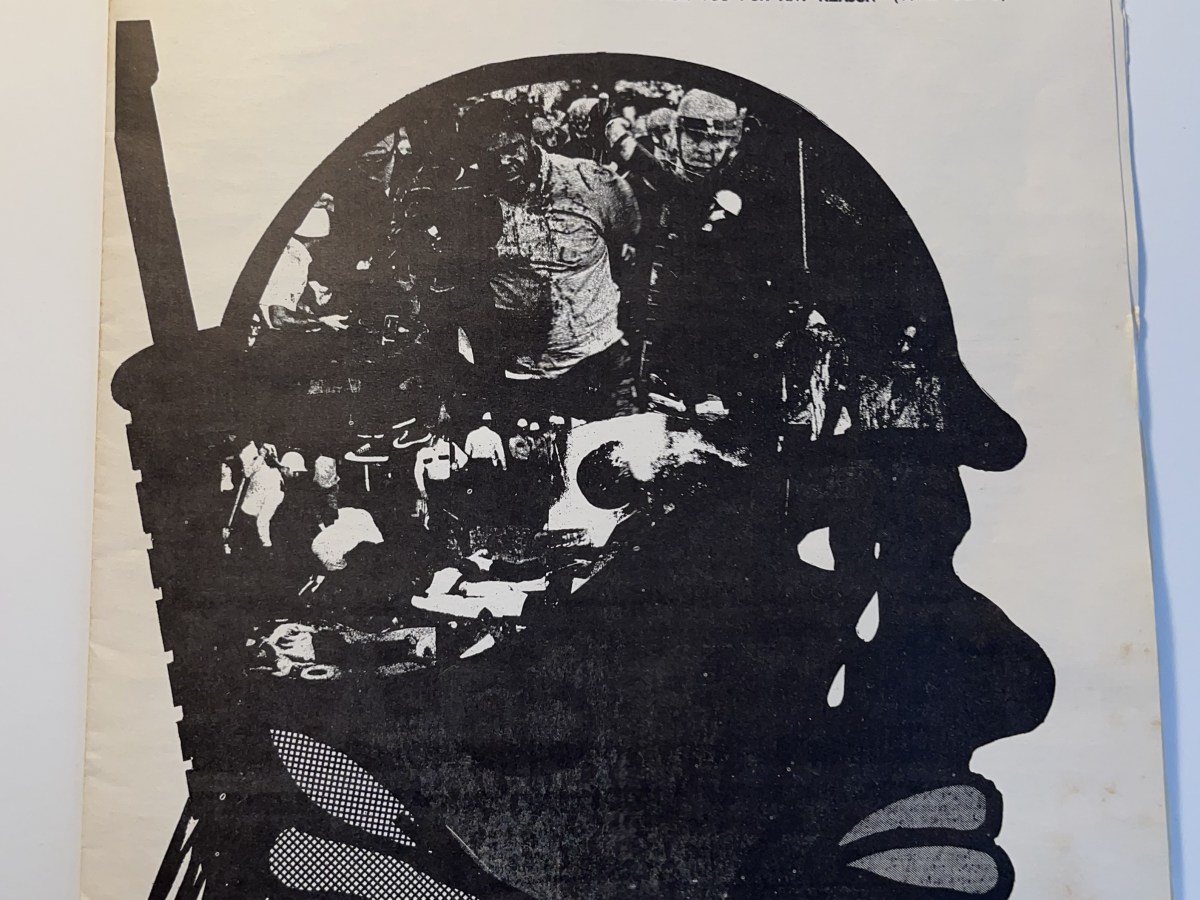
Remembering the Student-G.I. Anti-War Movement
When I came home from Europe in August 1968, the antiwar movement was not new but it was gaining momentum. Young guys my age faced the threat of induction. I was called up twice for the pre-induction physical, but I managed to stall the first draft order by extending my student deferment and the second by submitting a conscientious objector claim on humanitarian grounds. This confused my draft board just enough so that my newly assigned lottery number put me barely over the line. When I was safe at last, a stomach ulcer I had been suffering for years magically…
Keep reading
An Incident to End an Age: Kickapoo Creek 1970
Just over 52 years ago, between 30,000 and 60,000 people camped out on a muddy farm near Heyworth for Illinois’s own Woodstock: The Incident at Kickapoo Creek. Logan Janicki For college students across Illinois and neighboring states, L. David Lewis could hardly have chosen a better time to hold his “love affair” between “the electronic miracles and the human sounds of the soul,” the Incident at Kickapoo Creek outdoor rock concert. Nixon’s promise of law and order had proven to be nothing but the boot of the man coming down to crush peaceful dissent and hope for a better world.…
Keep readingSelfies and Cancel Culture: The Political Economy of Self-Esteem
Recently, The New York Times ran one of those insipid “Ask the Celebrities” features by asking, “What will later generations find most objectionable about the culture of the early 2020s?” Most of the responses misconstrued the question by pointing to things that have been around for a very long time (“eating dead animals”). But a couple of replies caught my attention: selfies or self-obsessed postings was one and cancel culture another. Aren’t these things superficially opposites? The one craves attention at all costs, eschewing privacy and coveting the limelight. The other compulsively restricts interaction with another or with others. The…
Keep readingLeo Tolstoy and the Forgotten Sources of Depression
David Brooks recently published an editorial on the death by suicide of his best friend, a highly intelligent man of outstanding accomplishment with a loving family and devoted friends. As in most discussions of depression, the article does not question the medical interpretation of his friends’s condition, though the friend received the best possible medical and therapeutic treatment. To no avail. Obviously the causes of depression must be diverse; and no outsider can possibly have an insight into the plight of an unknown other. But it strikes me that one cause is hardly ever entertained: the profoundly depressing and accurate…
Keep readingFreedom and Suicide
I want to recommend a French author I’ve become addicted to (though I don’t find his person always very sympathetic): Emmanuel Carrère. I mentioned before that he’s been called the French Knausgaard, though admittedly that’s not necessarily a high recommendation in my opinion. I would be curious what any survivor of a mental crisis or psychotherapy would make of him. In his book Le Royaume (The Kingdom), Carrère tells this story about one of his worst mental crises. In desperation, he goes to one of the most prestigious Paris analysts, an older psychiatrist named Roustang, and tells him he’s contemplating…
Keep readingWho Else Has Been Ghosted Lately?
I perceive contemporary social relationships as afflicted by an invisible epidemic of hypersensitivity and avoidance. As for me, I am a mild-mannered older man who never intends to give offense. Nevertheless, since the pandemic began I have succeeded in offending two longstanding friends to such a degree that they broke off contact with me and refused to respond to my inquiries about what was wrong. The first was an old acquaintance with whom I interacted often during the pandemic. Our interactions included drinks and meeting socially. Since this individual does not drive, I provided him needed transportation on several occasions.…
Keep readingWhat Makes French “Critical Theory” so Distinct?
During my graduate study and career, I disliked the cult status of French critical theory in American English departments. This began after the 1960s and lasted until around the turn of the century. I had come of age at a time when Marx, Hegel, Sartre, and Lukács still set the tone. I was convinced that much remained to be done by following (and correcting) their course. Recently, I was relieved to meet excellent French scholars who despise the French celebrity theoreticians as much as I do. It was only upon discovering the atypical Alain Badiou that I became more curious…
Keep readingAmerican Midnight and my Personal Reflections on our Heart of Darkness
An historian friend smugly assures me that professional historians have not neglected the years 1917-20, which saw American participation in the war in Europe and repression at home. That is no doubt true, but what distinguishes American Midnight from all the discussions of its various sub-histories is its insistence that the seemingly separate strands of violence and oppression form an inextricably bound whole. Veterans of the Indian Wars and the brutal suppression of the Philippine Moro freedom fighters brought their taste for and techniques of violence to bear on anarchist strikers and socialists at home and clamored for American involvement…
Keep readingThe Political and the Apolitical Historian
I was recently introduced to Reinhart Koselleck by an article in aeon (an excellent magazine, by the way) about his historical theories. The article juxtaposes Koselleck with the communist Eric Hobsbawm, whose historical method was a direct outgrowth of his communist politics. For Hobsbawm, history was praxis. The journal he helped found, Past and Present, and his participation in the Historian’s Group of CPGB made these connections explicit through academic research and political engagement respectively. Koselleck rejected this entirely. He could not stand anachronisms and what could be more anachronistic than reading our moment onto the past. To explain this,…
Keep readingThe Immigrant Flood as “Event”
The New York Times this morning (Dec. 15, 2022) carried an article about the unbearable pressure caused by the overwhelming and rising number of immigrants crossing the border into the relatively welcoming city of El Paso, Texas. Demonized by conservatives, ignored as much as possible by the Democrats whose program offers no solution, the accelerating arrival of masses composed of people who want nothing other than what any of us wants: security, survival, opportunity—their mass may be the element that defies the rules and customs of a social-historical “situation” and in doing so creates the precondition of a transforming “event”…
Keep readingJoseph Conrad and V. S. Naipaul: politically correct or piously racist?
We tend to see political correctness and “cancel culture” through the jaundiced eyes of right-wing commentators. A closer look at two cases reveals the degree to which our own authoritarianism has succeeded in sanctioning what is blatantly racist and, conversely, in imposing upon one of the most effective denunciations of racism and imperialism a proscription by and for the Left. American English departments soon obediently fell in line with Nigerian Nobel Prize winner Chinua Achebe’s judgment that Joseph Conrad’s anti-imperialist novel Heart of Darkness “dehumanizes” all Africans. This verdict rested on an equivocation that English teachers should have corrected in…
Keep readingA World Turned Inside Out
We have a fondness for the metaphor of a world turned upside down. It is a preferred metaphor of history writing and history-making. Successful revolutions are said “to turn the world upside down.” Marx supposedly turned Hegel’s dialectic upside down (or right side up depending on how one sees it). We need a new metaphor for conceptualizing the perspective of global history and focalizing the trends that now embody the developments of globalization: that of a world turned inside out. The story we tell ourselves about the emergence of the West and about the blank backwardness of “the Rest” is…
Keep readingIt’s Politics, Stupid!
At a one-day conference about public ceremonies in the Fifth Republic that I recently attended, Xavier Darcos gave a short presentation about France Mémoire, the organization that he is the director of. With the help of government funding, Darcos explained that France Mémoire is meant to depoliticize memory in France by promoting its most harmless elements (Proust, Pasteur, and Champollion’s deciphering of Egyptian hieroglyphs, for example) which he claims have come under attack by a force that he jeeringly calls “wokeisme.” He went on to share his horror of a new generation of historians who are no longer interested in…
Keep readingBadiou’s Wrong Turn Between the One and the Many
Badiou’s conversion, which he himself has called his “road to Damascus” (alluding to the exemplary mystical conversion of the Apostle Paul), was his experience of the solidarity of French students and workers in May 1968. It was an event that could claim universal significance. It seemed to echo the Maoist Chinese Cultural Revolution, and it occurred in synch with a global watershed of two epochs, one the aftermath of World War II, the other the new age which understood itself, however vaguely, as a revolutionary new beginning of the baby boomer generation. But the revolutionary aspirations of 1968 faded. They…
Keep readingGetting Our Minds Around the Global Expansion of Capital
Globalization doesn’t result from a few bad decisions by Democratic politicians in the mold of a Bill Clinton or a Tony Blair. Anyone with a clue about how the world works can see that competition compels firms to search for raw materials, cheap labor, and lucrative markets beyond national boundaries. Globalization is something more deeply rooted and driven than all the debates over Brexit, NAFTA, or the Great Wall of Trump can possibly convey. Expansion and growth toward a global horizon are the core dynamic of capitalism. Yet it’s one thing to say this and something altogether different to grasp…
Keep readingThe Dialectic of the Normal and the Abnormal
The new Puritanism of our “cancel culture” of the Right and of the Left has not only rendered certain words and behaviors unutterable. Since those words and actions were not as rigorously sanctioned in the past, the past itself has come to seem unbearably obscure and evil. The past is an unthinkable darkness. An unintended but inevitable consequence is that the present and we who inhabit it have come to seem (at least to ourselves!) unbelievably pure and righteous by comparison. The same dialectic operates synchronously when we think about contemporary societies that do not share our purity: the darker…
Keep readingA Badiouvian Reading of Emmanuel Carrère
If you can recall a college roommate whom you mildly disliked yet shared unforgettable experiences with, this is how I feel about reading the books of the French author Emmanuel Carrère. He was once referred to as “the French Knausgaard”—the ultimate hypnotically self-absorbed author. He can’t rue his male malfeasance without regaling us with the sex tricks he performed with his ever-so-beautiful wives. An ex-wife is suing him for indiscretion. His unreservedly honest (at least according to him) confessions tend to relativize his sins while stunning the reader with their lurid explicitness. I don’t admire his personality or approve of…
Keep readingApocalypse or Liberation: Narrative Patterns of Opposition
Where are we in the swirling ocean currents of history? Postmodernism has gotten us used to speaking of and distancing ourselves from the so-called “grand narratives”: the narratives of continual progress or revolution or regression. We could carry this metaphor of narrative structure further by attending to the motifs or recurring plot figures that historical actors impose in enacting history or scribes invent in recording it. Like any narrative, history is conflict and hence opposition. One can no more deny the presence of opposition than one can deny the passing of time. But the shape or terms of opposition are…
Keep readingOn the Meaning of Multiple Worlds
On this quiet gray Saturday afternoon, in the last days before an election that seems to come at us like a road approaching a chasm without a bridge, I read two interesting articles in short order. The first by Stephanie Burt writing in The New Yorker (“The Never-Ending Story”) is about the prevalence of the many iterations of the theme of multiple simultaneous worlds. The article tracks this theme from science into science fiction to Marvel comics and their cinematic offshoots and finally beyond the market-driven entertainment industry into more serious recent literature and poetry. The article quotes the hypothesis…
Keep readingDiscovering Alain Badiou
I discovered Alain Badiou when I was holed up in a Montmartre apartment last November, collaborating on a research project by day and trying to improve my uncertain French comprehension in the evenings. In search of a clear, cognate-rich French, I googled politicians and authors. Then I happened upon Badiou about whom I knew almost nothing. After listening to a few of his presentations, I felt as if I had tuned in to Socrates himself. Like the Socrates of Plato’s dialogues, Badiou remains congenial even while mercilessly deflating the weaker premises of his interlocutors by asking essential questions. In a…
Keep readingFriends, Darren Bailey is Annoying
Within three weeks, the short-to-long-term future of our great state, Illinois, will be settled. The Governor’s race is underway and has attracted the casual interest of its residents. Like most of the voting public, I am dim-witted and ill-informed about the race. My mental sketch of J.B. Pritzker and his term as governor: He is a very large man who has a penchant for politically baby-stepping the state away from “another shithole” status. Illinois is in the process of raising its minimum wage to $15 an hour year over year. He capped the price of Insulin, and legalized Marijuana recreationally.…
Keep readingThe Luxembourgish Ideology
Before I was born Richard Barbrook and Andy Cameron summarized the beliefs of Silicon Valley as The Californian Ideology. Techno-utopianism, “free market economics, and counter-culture libertarianism” grafted itself onto the organs of ‘Actually Existing Capitalism’ like a virus, beginning a plague that has not been fought in the name of the immune-compromised but celebrated in the name of those with natural immunities. What is the Californian Ideology? We already know what it is, but it is hard to put it into words. New Left anti-corporate radicalism combined with free market capitalism. The idea that (until recently) the largest corporations on…
Keep reading Normal Thoughts