Now that I’ve realized that nothing is more important than not obsessing about my condition, and that one of the best palliative medications is memory, I’m indulging mine and finding that it’s more than ready to do its part. Pancake is a willing audience with his experiences that resonate with mine.
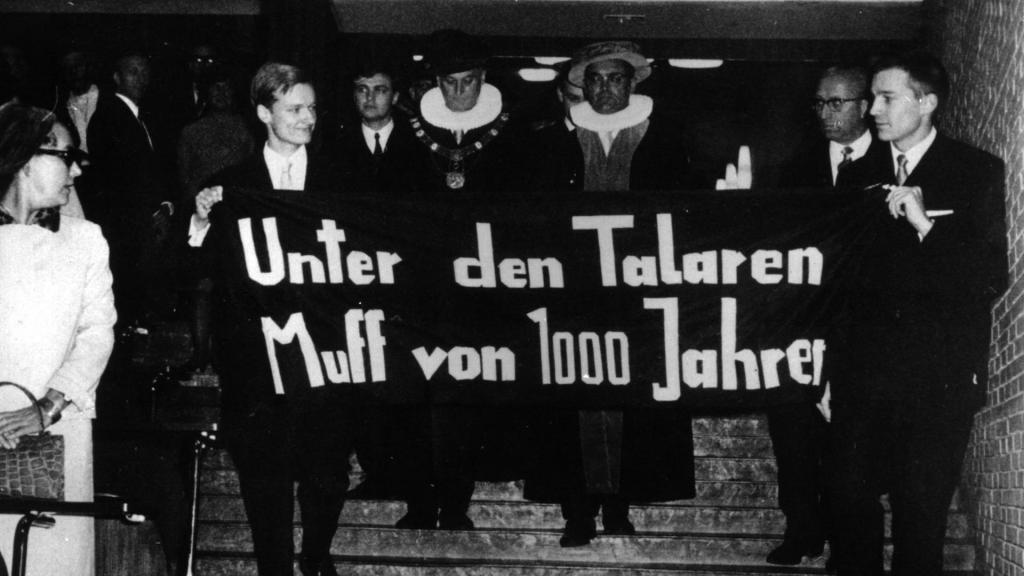
This rainy Friday in May reminds me of a perpetually rainy Hamburg where I arrived—clueless—on a Friday in early September 1967. Since it was at the Dammtor station that I arrived at the university and where I frequently came and went, the neat little remnant of the prewar city stands out in my memory. I recall exiting to face, utterly bewildered, the battle lines of police and protesting students. It seemed to me that such battles were weekly occurrences, that every week or so some sensational report or rallying cry galvanized the milling crowds and transformed them from a neutral mass into a polarized and politicized force. There was the death of Che Guevara in Bolivia, the escalations of the Vietnam War; the assassinations of Martin Luther King and Bobby Kennedy, and, closer to us, the unfolding sensational events that exploded in that smaller Federal Republic of Germany like bombs in a fortified chamber. There was the scandalous opening ceremony of the university where leftist students—dressed formally in suits and ties—held up a banner ridiculing the medieval attire and retrograde mentality of the officers of the university (“Unter den Talaren, der Muff von Tausend Jahren“). German favors pithy rhyming sayings, and this banner was a gut punch that declared that beneath the ridiculous formal headgear of the strutting professors moldered the sordid residue of a millennium, or of the Thousand-Year Reich! One of the ridiculed professors stepped out of line to scream at the protesters, “You all belong in the concentration camp!” A bit of research confirmed that he had experience putting people in concentration camps. The university erupted in a fury that flared up again throughout the academic year 1967-68. Since parallel uprisings and stirrings were happening almost everywhere, it became the fabled year ’68, a year that acquired the same epochal ring as 1848.
Historians might want to argue that no such juncture exists; that 1968 had been years in the making; that it differed from country to country; and that it blended into the years that followed. All well and good. But I still have to defend the notion of an epochal turning point with the shorthand of “68.” At a certain point, the “movement” that had been gaining momentum with such antecedents as the previous year’s Pentagon March and the anti-Shah demonstrations in West Berlin acquired a critical mass. Previously quiet centers such as the relatively sedate Paris exploded in watershed eruptions in that year. Large numbers of previously apolitical or conventional young people experienced a change of heart. My recollection is that in Hamburg every student I knew was excited by the change and partisan to the charismatic standard bearer of the Left, Rudi Dutschke. After all, hardly a member of that generation had grown up outside the shadow of authority figures who had conformed to or served under the Nazi regime. The lesson we absorbed was that conformism and blind obedience to authority were evils condemned by history.
This was the antiauthoritarian phase of the extended 1960s. That phase had to take place for several reasons. First of all, no one left to his or her own devices could transition from one system of beliefs to another without a transitional phase where everything is in doubt and the world is up for grabs. Second, more than in our time of disparate media outlets, the events of 1968 were dropped on the population like bombshells, not filtered and funneled via our cell phones. I remember the hue and cry in front of the auditorium when someone shouted out the death of Che. I remember the German woman staring over my shoulder and gasping when I waited for my train at Dammtor station with the murder of MLK headlining my newspaper. I remember the outcry of my fellow dorm residents in the television room when it was confirmed by handwriting experts that German president Heinrich Lübke had indeed built concentration camp barracks during the Third Reich. Of course, even then the news was mediated, but mediation is a matter of degrees. By comparison, we were hit by those bombshells harder and more precipitously than anything today. Today we all take in our news on a private basis. I doubt if those instantaneously galvanized crowds are possible now. Someone needs to study this. It’s rain-swept now in Montmartre, the way it always seemed to be raining at Dammtor station.
Signed,
Andrew (Weeks)
 Normal Thoughts